








After cataract surgery in Indore , use your eye drops on time, wear the eye shield as advised, keep water, dust, and soap out of the eye, and never rub or press it. Avoid heavy lifting, swimming, and eye makeup until your surgeon allows. Most people notice clearer vision within a few days, and the eye heals fully over about four to six weeks. Attend every follow-up visit, and see your doctor urgently if you have severe pain, worsening redness, or sudden vision loss.
What to Expect After Cataract Surgery
Cataract surgery is a short, day-care procedure in which the cloudy natural lens is replaced with a clear artificial lens (a new eye lens, or IOL). The eye then needs time to heal from the tiny incision.
In the first days, it is normal to have:
- Mild itching or a gritty feeling
- Watering and light sensitivity
- Slightly blurry or hazy vision that improves daily
- Mild redness
Your surgeon will tell you exactly how long each precaution applies, because it depends on your eye, the surgery type, and your health.
Recovery Timeline at a Glance
| Stage | What to expect | What to focus on |
| First 24 hours | Mild discomfort, blur, watering | Rest, eye shield, start drops, first check-up |
| First week | Vision improves, mild grittiness | Drops on schedule, no rubbing, keep water and dust out |
| Weeks 2 to 4 | Most activities resume | Continue drops as tapered, avoid swimming and strenuous work until cleared |
| Around 4 to 6 weeks | Vision settles | Final check-up, glasses prescription if needed |
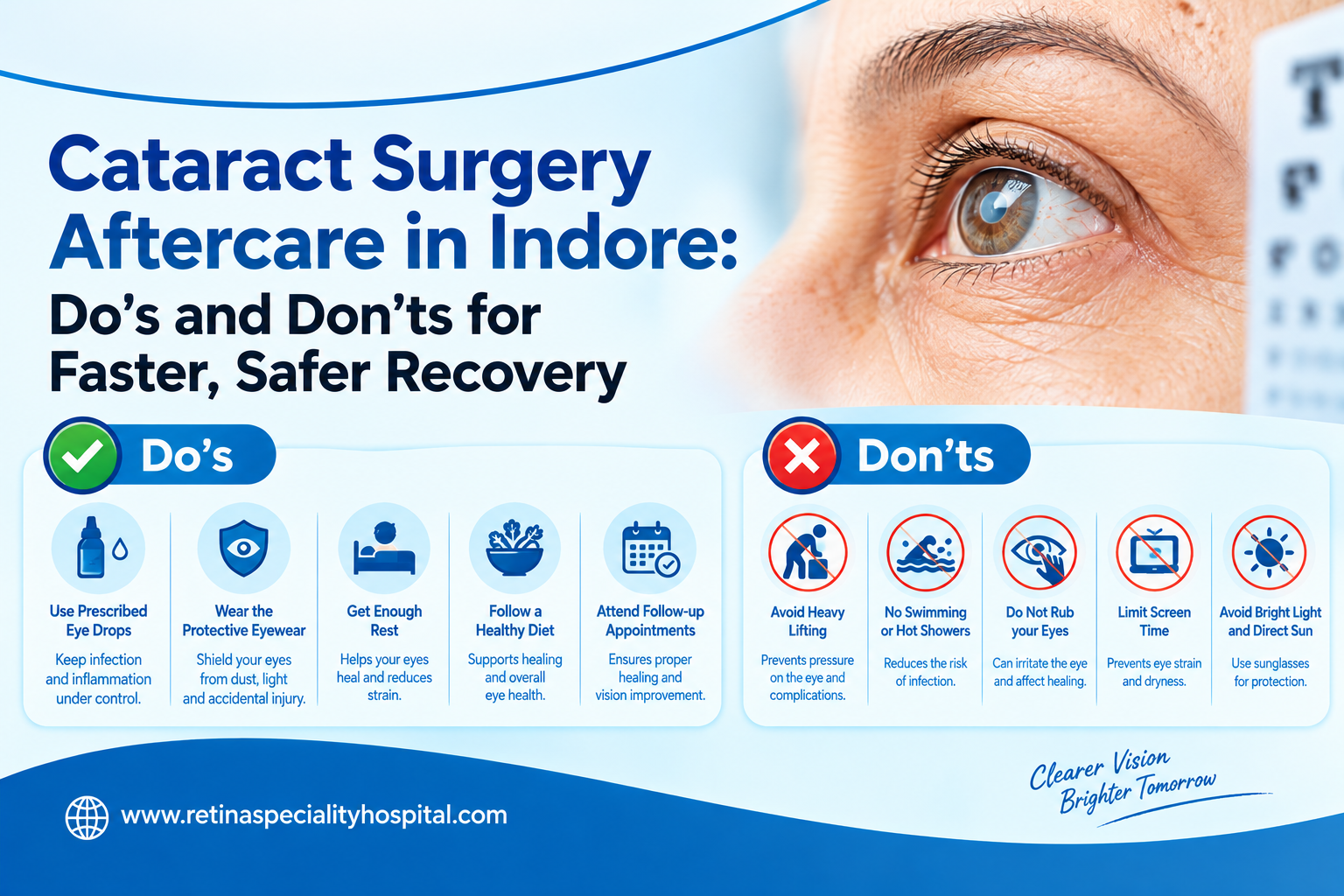
Do’s After Cataract Surgery
1. Use your eye drops exactly as prescribed
You will usually get antibiotic, anti-inflammatory, and sometimes lubricating drops. They prevent infection and swelling, so do not skip or stop them early.
Drop tips:
- Wash your hands before every dose
- Do not let the bottle tip touch the eye or eyelid
- Wait a few minutes between different drops
- Follow the tapering schedule your doctor gives
2. Wear the eye shield as advised
A shield protects the eye from accidental rubbing or pressure, especially during sleep. Your doctor will tell you how many days to use it.
3. Wear sunglasses outdoors
The eye is light-sensitive after surgery. Sunglasses also protect from dust and wind.
4. Clean around the eye gently
Use a clean, soft, damp cloth or sterile cotton to wipe away discharge or tears. Wipe from the inner corner to the outer corner, and use a fresh piece each time.
5. Sleep on your back or on the opposite side
This avoids pressure on the operated eye.
6. Eat well and keep your sugar and blood pressure under control
Good general health supports healing. If you have diabetes, stable sugar is especially important. Read our guide: Is Cataract Surgery Safe for People with Diabetes?
7. Attend every follow-up visit
Your doctor checks healing, eye pressure, and vision at scheduled visits. Do not skip them even if you see well.
Don’ts After Cataract Surgery
1. Do not rub, press, or squeeze the eye
This is the most important rule. Rubbing can disturb the incision and the lens position.
2. Do not let water, soap, or shampoo enter the eye
For the first week or as advised, wash your face with a damp cloth and take care while bathing or washing hair. Tilt your head back to wash hair.
3. Do not swim or use hot tubs
Avoid swimming pools, rivers, and similar water until your surgeon permits, usually for a few weeks.
4. Do not lift heavy weights or strain
Avoid heavy lifting, intense exercise, and straining, because they can raise eye pressure. Avoid bending with your head below your waist in the early days.
5. Do not use eye makeup or creams near the eye
Wait until your doctor allows. Makeup particles can cause infection.
6. Do not go to dusty or smoky places
Avoid construction dust, smoke, and crowded polluted areas in the early weeks.
7. Do not drive until your doctor clears you
Your vision needs to settle, and depth perception may take time.
8. Do not use home remedies or old drops
Do not put rose water, turmeric, or any unprescribed drop into the eye. Do not use leftover drops from earlier treatments.
9. Do not stop drops or skip follow-ups early
Feeling better does not mean the eye has healed.
Quick Do and Don’t Table
| Do | Don’t |
| Use drops on time | Rub or press the eye |
| Wear the shield at night as advised | Let water, soap, or dust enter the eye |
| Wear sunglasses outdoors | Swim until cleared |
| Wash hands before touching near the eye | Lift heavy weights or strain |
| Sleep on your back or the other side | Apply eye makeup early |
| Keep sugar and BP under control | Use home remedies or unprescribed drops |
| Attend follow-ups | Drive before clearance |
Can You Use Screens, Read, or Watch TV?
Yes. Reading, TV, and mobile use will not harm the eye. If your eyes feel tired or dry, take breaks and blink often. Use lubricating drops only if your doctor has prescribed or approved them.
What Is Normal and What Is Not?
| Normal in the first few days | Call your eye doctor |
| Mild itching or gritty feeling | Severe or increasing pain |
| Watering | Redness that is getting worse |
| Mild blur that improves | Sudden drop in vision |
| Light sensitivity | Thick discharge or swelling of the lids |
| Seeing halos or glare at first | Flashes of light, many new floaters, or a dark curtain |
| Slight redness | Severe headache with nausea or vomiting |
Sudden pain, vision loss, or a shadow in the vision needs urgent attention, as these can point to infection, high eye pressure, or a retinal problem.
Blurry Vision After Cataract Surgery: When Is It a Concern?
Mild blur in the early days is common. If blur appears or returns weeks later, the cause may be swelling at the retina, dry eye, a change in glasses power, or, months to years later, a cloudy capsule known as PCO, which is treated with a quick YAG laser. Read more: Why Is Vision Blurry After Cataract Surgery?
For problems involving the back of the eye, a retina specialist in Indore can examine the retina and advise treatment.
When Can You Get New Glasses?
Your eyes keep changing for a few weeks. Doctors usually advise waiting about four to six weeks, or until your vision is stable, before checking for glasses. Many people need reading glasses even after a standard lens, unless a premium or multifocal lens was chosen.
Is Emergency Cataract Surgery Ever Needed?
Cataract surgery is usually planned. Urgent surgery may be needed in situations such as an eye injury that damages the lens, or a swollen lens that raises eye pressure. Any sudden painful vision change should be seen by an eye doctor immediately. Do not wait for a cataract to become very dense, as advanced cataracts can make surgery more complex.
Cost of Cataract Surgery: Motiya Bind Operation Cost in Indore
Many people search for the motiya bind operation cost before deciding. The cost depends on:
- The surgery type (standard phaco, laser-assisted, or complex cataract management)
- The type of lens (monofocal, multifocal, toric, and other premium options)
- The condition of your eye and any other eye problem
- Hospital facilities and follow-up care
- Insurance or cashless coverage
How to Choose the Best Cataract Surgeon and Hospital in Indore
There is no single “best cataract surgery” for everyone. The right surgery depends on your eye. When looking for the best cataract surgeon or the best eye hospital in Indore, consider:
- Surgeon experience in cataract and lens (IOL) surgery
- Whether the doctor explains lens options and costs honestly
- Availability of cornea, glaucoma, and retina care if you need it
- A clear follow-up plan
- Comfort and communication
Cataract Surgery Services at Retina Speciality Hospital, Indore
| Service | Best suited for |
| Phacoemulsification (Micro-Incision Cataract Surgery) | Most standard cataracts |
| Premium / Multifocal IOL Lens Surgery | Patients who want less dependence on glasses |
| Complex Cataract Management | Dense cataracts, small pupils, weak lens support, past eye surgery or injury |
As an eye care centre in Indore, Retina Speciality Hospital also offers retina care, so related problems can be assessed under one roof. [Confirm services with the hospital.]
Meet Retina Doctors
Dr. Ritu Verma
Senior Consultant, Cataract, Refractive & Cornea Surgeon | MBBS, DOMS (Ophthalmology)
Specialities: Cataract & IOL Surgery, LASIK (Refractive Surgery), Cornea, Conjunctivitis
Book Appointment with Dr. Ritu Verma
Dr. Rohit Khatri
Senior Consultant, Cataract, Refractive & Glaucoma | MBBS, MS, FNABEH, FICO
Experience: Ex-Consultant, Sankara Eye Centre, Indore; Ex-Consultant, Dr. Agarwal’s Eye Hospital, Indore
Specialities: Cataract Surgery, Refractive Surgery, Glaucoma Management
Book Appointment with Dr. Rohit Khatri
For Retina Follow-Up: Dr. Arun Bhargava and Dr. Deepanshu Agrawal
If your cataract surgery is complicated by a retina problem, or you have conditions such as diabetic retinopathy, our vitreoretinal surgeons can help.
- Dr. Arun Bhargava, Senior Consultant and Vitreoretinal Surgeon (MBBS, MS, DNB, FICO, FRCS, FMRF). Specialities: Retina & Vitreous, Uvea & Ocular Inflammation, Diabetic Retinopathy, Age Related Macular Degeneration. Book Appointment
- Dr. Deepanshu Agrawal, Senior Consultant and Vitreo Retinal Surgeon (MBBS, DO, DNB, FVRS). Ex-Consultant, Choithram Netralaya. Book Appointment
FAQs About Cataract Surgery Aftercare in Indore
1. What should I do after cataract surgery?
Use your drops on time, wear the shield and sunglasses as advised, keep the eye clean and dry, and attend follow-up visits.
2. What should I avoid after cataract surgery?
Avoid rubbing the eye, water, soap, and dust in the eye, swimming, heavy lifting, eye makeup, and driving before clearance.
3. How long does recovery take after cataract surgery?
Vision often improves in a few days, and complete healing takes about four to six weeks.
4. When can I wash my hair or face?
You can wash with a damp cloth and take care to keep water out of the eye. Your doctor will tell you when normal washing is safe.
5. When can I watch TV or use my phone?
Usually from the same or next day. Take breaks if your eyes feel tired.
6. When can I drive after cataract surgery? Only after your doctor confirms that your vision is good enough and safe.
7. Is it normal to see blur or halos after surgery?
Mild blur and halos in the early days are common and improve. Report anything that gets worse.
8. When will I need glasses?
Your doctor usually checks for glasses after about four to six weeks, when vision has settled.
9. What is the motiya bind operation cost in Indore?
It depends on the surgery type, lens, and hospital. Contact us for an estimate based on your eye.
10. Is laser cataract surgery recovery different?
The aftercare is broadly similar. Follow your surgeon’s instructions.
11. Can children get cataracts?
Yes, though it is uncommon. Children with cataracts need specialist child eye care in Indore, so a child with a white pupil or poor vision should see an eye doctor early.
12. Who is the best cataract surgeon in Indore?
The right surgeon is one who examines you carefully and explains your options. At Retina Speciality Hospital, Indore, cataract surgery is led by Dr. Ritu Verma and Dr. Rohit Khatri.
Conclusion
Cataract surgery is quick, but good recovery depends on what you do afterwards. Use your drops, protect the eye, avoid rubbing and water, and keep your follow-up appointments. Call your doctor at once if you notice severe pain, worsening redness, or sudden vision loss.
Book Your Cataract Check-Up Today
For cataract surgery or aftercare, consult Dr. Ritu Verma or Dr. Rohit Khatri at Retina Speciality Hospital, Indore. Call 9425056374 or Book an Appointment now.