







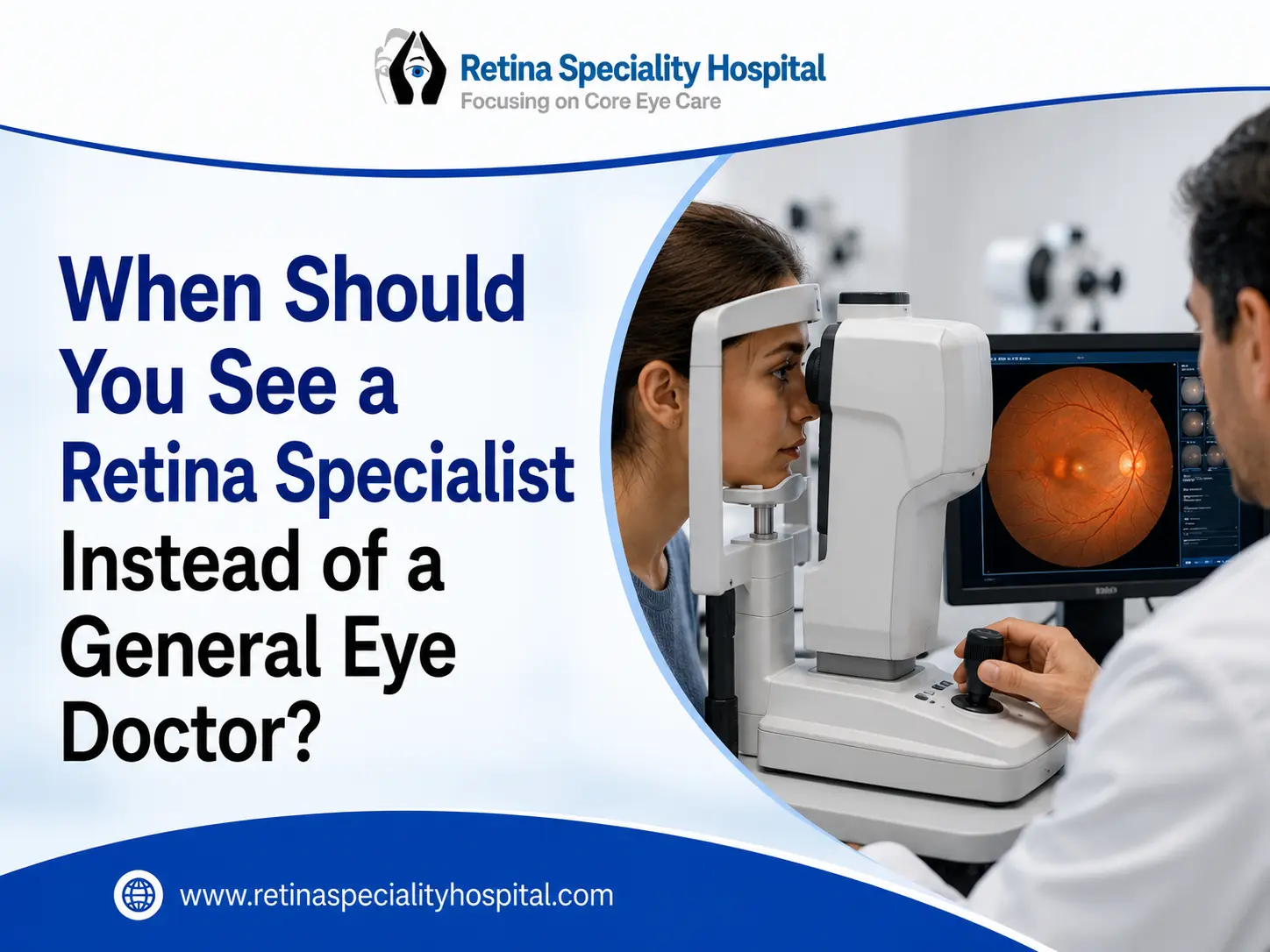
You should see a retina specialist when you notice sudden floaters, flashes of light, a shadow or curtain over your vision, blurred or distorted central vision, or when a routine eye exam finds a problem at the back of your eye. A general eye doctor handles everyday vision needs, but the retina is delicate, and certain warning signs need an expert who focuses only on it.
This guide explains the difference between the two, the exact symptoms that call for a retina doctor, and the conditions that make early referral so important for protecting your sight.

Retina Specialist vs General Eye Doctor: What Is the Difference?
A general eye doctor covers the basics of eye care. This includes optometrists, who test your vision and prescribe glasses or contact lenses, and general ophthalmologists, who diagnose common eye conditions and perform routine surgery such as cataract removal.
A retina specialist is an ophthalmologist who has completed extra fellowship training in diseases of the retina and vitreous. The retina is the light-sensitive layer at the back of your eye, and the vitreous is the gel that fills the eyeball. These experts are also called vitreoretinal surgeons.
In short, a general eye doctor is often your first point of contact, while a retina specialist handles complex problems deep inside the eye. Knowing which one to visit can save valuable time when your vision is at risk.
| Feature | General Eye Doctor | Retina Specialist |
| Main focus | Vision checks, glasses, common eye issues | Diseases of the retina and vitreous |
| Training | Optometry degree or general ophthalmology | Ophthalmology plus retina fellowship |
| Common care | Eye tests, cataracts, dry eye, infections | Diabetic retinopathy, retinal detachment, macular problems |
| Typical tools | Basic eye exam, refraction | OCT scans, fundus angiography, laser, vitrectomy |
| When you visit | Routine and preventive care | Advanced diagnosis and retinal surgery |
When Should You See a Retina Specialist? Key Warning Signs
Some eye symptoms are urgent, and knowing them helps you act fast. When you should see a retina specialist usually comes down to sudden changes in how you see, especially in one eye.
Book an appointment with a retina doctor if you notice any of these signs:
• A sudden increase in floaters, the small specks or threads that drift across your view
• Flashes of light, like camera flashes, even with your eyes closed
• A dark shadow or curtain moving across part of your vision
• Blurred, wavy, or distorted central vision, where straight lines look bent
• A blind spot or missing patch in the centre of your sight
• Sudden loss of vision in one or both eyes
These symptoms can point to a retinal tear, a retinal detachment, or bleeding inside the eye. Do not wait for them to pass, because the retina can be damaged in hours or days. Fast treatment often makes the difference between saving and losing sight.
Retinal Conditions That Need Specialist Eye Care
Many back-of-the-eye diseases are painless in the early stages, which is why they are easy to miss. A retina specialist is trained to catch and treat these conditions before they steal your vision.
Common retinal disorders that need expert care include:
• Diabetic retinopathy, damage to retinal blood vessels caused by long-term diabetes, and a leading cause of vision loss in adults. Learn more about our diabetic retinopathy programme.
• Age-related macular degeneration (AMD), which affects the macula and blurs the sharp central vision you need to read and drive.
• Retinal detachment, when the retina peels away from the back of the eye. This is an emergency that may need surgery such as vitrectomy or scleral buckling.
• Macular hole and macular oedema, small breaks or swelling in the central retina that distort vision.
• Retinal vein occlusion, a blockage in the eye’s veins that can cause sudden blurring.
• Retinopathy of prematurity (ROP), an abnormal growth of retinal blood vessels in premature babies that needs timely ROP screening.
If you live with diabetes or high blood pressure, or if retinal disease runs in your family, regular checks with a retina specialist are a smart form of protection.
What Happens During a Retina Specialist Consultation?
A visit to a retina doctor goes deeper than a standard eye test. The goal is to see the retina clearly and measure any damage with precision.
Your consultation usually includes:
• Dilated eye exam, where drops widen your pupils so the doctor can view the entire retina.
• Optical Coherence Tomography (OCT), a painless scan that creates detailed cross-section images of the retina. See how OCT imaging works.
• Fundus Fluorescein Angiography (FFA), which uses a dye to map blood flow and leaks in the retinal vessels. Read about fundus fluorescein angiography.
Based on these findings, your retina specialist may recommend monitoring, laser treatment, injections, or surgery. Because the tests are detailed, the diagnosis is accurate and the treatment plan is tailored to your eyes.
Frequently Asked Questions
1. Can a general eye doctor treat retinal problems?
A general eye doctor can detect early signs of retinal problems during an eye exam and manage simple issues. However, complex conditions like retinal detachment, diabetic retinopathy, and macular degeneration need a retina specialist with advanced training, imaging, and surgical tools. In most cases, your general eye doctor will refer you to a retina specialist for expert treatment.
2. Is a retina specialist the same as an ophthalmologist?
Every retina specialist is an ophthalmologist, but not every ophthalmologist is a retina specialist. A retina specialist is an ophthalmologist who has completed additional fellowship training focused only on the retina and vitreous. This means they are equipped to handle the most delicate and advanced eye conditions.
3. How often should you see a retina specialist?
If you have no symptoms or risk factors, a routine eye exam with a general eye doctor is usually enough. If you have diabetes, high blood pressure, high myopia, or a history of retinal disease, you may need a retina check once a year or as advised. Anyone with sudden floaters, flashes, or vision loss should see a retina specialist right away.
Protect Your Vision With Central India’s Retina Experts
Your eyesight is too precious to leave to guesswork. If you notice any warning signs, or if your general eye doctor has flagged a problem at the back of your eye, the specialists at Retina Speciality Hospital, Indore are here to help with advanced diagnosis and personalised treatment.
Call 0731-2553377 or book your appointment online today, and give your vision the expert care it deserves. Meet our retina specialists to get started.