








Millions of people around the world have had LASIK surgery and woken up the next morning able to see clearly without glasses. It is one of the most performed elective surgeries globally, with over 40 million procedures done worldwide since it was first introduced. In India, the demand for LASIK treatment in Indore and other major cities has grown significantly over the past decade as more people look for a long-term solution to blurry vision. But the question that almost every patient asks before booking a consultation is simple: is LASIK surgery 100 percent successful?
The honest answer is that no surgery carries a 100 percent guarantee. However, LASIK has one of the highest satisfaction rates of any elective procedure performed today, and understanding what success actually means can help you set the right expectations.
What Is LASIK and How Does It Work?
LASIK stands for Laser-Assisted In Situ Keratomileusis. It is a type of refractive eye surgery that reshapes the cornea to correct how light enters the eye.
When the cornea is incorrectly shaped, light does not focus properly on the retina. This causes blurry vision at various distances. LASIK uses a precise laser to remove a tiny amount of corneal tissue and correct this shape.
The procedure corrects three main vision problems:
- Myopia (short-sightedness): Difficulty seeing objects far away
- Hyperopia (long-sightedness): Difficulty seeing objects up close
- Astigmatism: Blurred vision at all distances due to an irregularly shaped cornea
The surgery takes about 15 minutes for both eyes. Most patients notice clearer vision within 24 hours of the procedure.
What Does a 96 Percent Success Rate Actually Mean?
When doctors say LASIK has a high success rate, they are referring to the percentage of patients who achieve 20/20 vision or better after the procedure. Research consistently shows this figure to be above 96 percent for suitable candidates.
However, success can mean different things to different people. Here is how it is typically measured:
- Visual acuity: Can the patient see 20/20 or better without glasses after surgery?
- Patient satisfaction: Is the patient happy with the result?
- Spectacle independence: Does the patient no longer need glasses or lenses for daily tasks?
- Stability: Has the vision remained stable over time without significant regression?
By all four of these measures, LASIK eye surgery in Indore and globally delivers strong results for the right candidates. The key phrase here is “right candidates,” which we will look at in detail.
Who Is a Good Candidate for LASIK Surgery?
LASIK does not suit everyone. The procedure works best for people who meet specific criteria. A thorough pre-surgical evaluation at a good eye hospital in Indore will determine whether you qualify.
Ideal candidates typically have:
- A stable prescription for at least one to two years
- Corneas that are thick enough for the laser to reshape safely
- No significant dry eye condition
- No active eye disease or infection
- Age between 18 and 40 years for the best long-term outcome
- Realistic expectations about what the surgery can achieve
People who may not be suitable for LASIK include those with very thin corneas, very high prescriptions, uncontrolled dry eye, or certain corneal conditions like keratoconus. In these cases, an eye specialist in Indore may suggest an alternative procedure.
Factors That Affect LASIK Eye Surgery Success Rate
Understanding what influences the outcome helps patients go into the procedure informed. The LASIK eye surgery success rate is not the same for every patient because several variables play a role.
Prescription strength: Patients with mild to moderate myopia achieve the most predictable results. Very high prescriptions carry a slightly higher chance of needing an enhancement later.
Corneal thickness: There must be enough corneal tissue for the laser to work safely. Thin corneas limit what can be corrected and may rule out the procedure entirely.
Age at the time of surgery: Younger adults with stable prescriptions tend to get the best long-term results. Patients over 40 may still develop presbyopia, which affects near vision regardless of LASIK.
Technology used: Bladeless, wavefront-guided LASIK delivers more precise results than older methods. The indore lasik laser centre you choose should have current equipment.
Surgeon experience: Outcomes are directly linked to the skill and experience of the surgeon performing the procedure.
LASIK Success Rate by Prescription Type
| Vision Problem | Prescription Range | Expected Success Rate |
| Mild Myopia | Up to -3.00 D | Over 99 percent |
| Moderate Myopia | -3.00 to -6.00 D | 96 to 98 percent |
| High Myopia | -6.00 to -10.00 D | 90 to 95 percent |
| Mild Hyperopia | Up to +2.00 D | 90 to 95 percent |
| Astigmatism | Up to 4.00 D | 92 to 96 percent |
| Mixed Astigmatism | Varies | 88 to 94 percent |
These figures represent the likelihood of achieving 20/20 vision or better without glasses. Even where full correction is not achieved, most patients see a significant improvement and reduced dependence on glasses.
What Are the Risks of LASIK Surgery?
LASIK is considered a safe procedure, but like any surgery, it carries some risks. Being aware of them helps patients make an informed decision about laser vision correction.
Common and usually temporary side effects include:
- Dry eyes, especially in the first three to six months
- Glare and halos around lights at night
- Sensitivity to bright light
- Fluctuating vision in the early weeks of recovery
Less common issues include:
- Under-correction or over-correction requiring an enhancement procedure
- Regression of vision over time, particularly in high prescriptions
- Flap complications in standard LASIK (rare with bladeless technology)
- Infection (very rare with proper post-operative care)
Serious complications from LASIK are rare when the surgery is performed on suitable candidates by an experienced top eye specialist in Indore. Most side effects resolve on their own within a few weeks to months.
The LASIK Recovery Process: What to Expect
One of the reasons LASIK eye surgery in Indore is so popular is the quick recovery. Most patients are back to normal activities within two to three days.
Here is what recovery typically looks like:
First 24 hours: Vision is often clearer almost immediately but may be hazy. The eyes feel gritty and watery. Rest is important.
Day 2 to 3: Most patients notice a significant improvement. Light sensitivity reduces. Many people return to work by day two or three.
Week 1 to 2: Vision continues to improve and stabilise. Follow-up visits are scheduled to monitor healing.
Month 1 to 3: Full stabilisation occurs for most patients. Dry eye symptoms, if present, usually improve during this period.
Beyond 3 months: Vision is stable for the vast majority of patients. Annual check-ups help monitor long-term eye health.
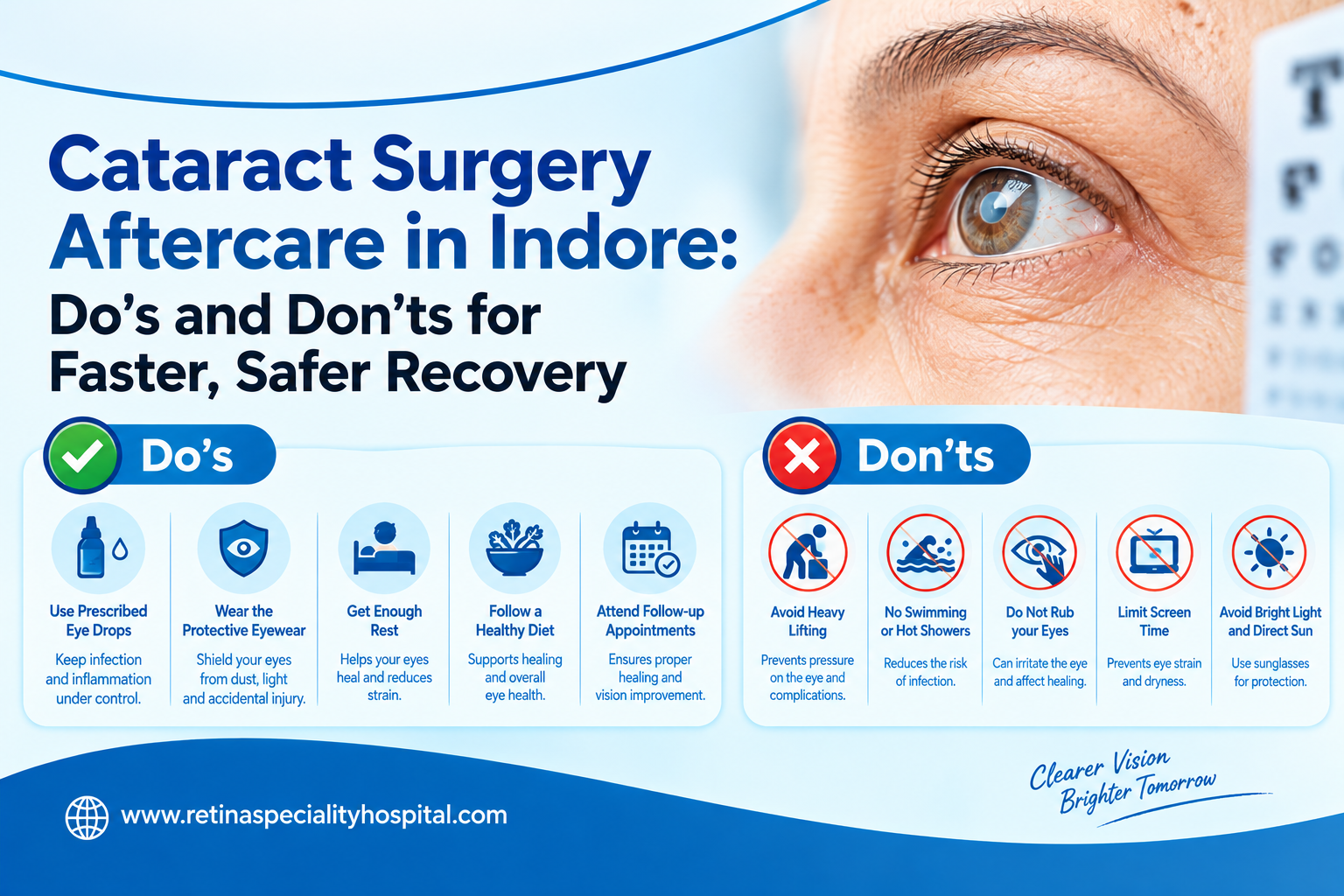
The LASIK recovery process is straightforward when aftercare instructions are followed carefully. Avoiding rubbing the eyes, using prescribed drops, and protecting the eyes from dust and direct sunlight all support healing.
Can LASIK Completely Remove the Need for Glasses?
For most patients, yes. Over 90 percent of LASIK patients achieve vision good enough to pass a driving test without glasses. Many achieve 20/20 vision or better.
However, LASIK does not prevent age-related vision changes. After the age of 40, most people develop presbyopia, which causes difficulty reading small print up close. This happens to everyone regardless of whether they have had LASIK or not.
A patient who had successful corneal reshaping treatment in their 30s may find they need reading glasses in their mid-40s. This is not a sign that the surgery failed. It is a natural part of how the eye ages.
For patients who want to address both distance and near vision, options like monovision LASIK or a combination approach can be discussed with an eye doctor in Indore during the consultation.
Why Patients Choose LASIK Treatment in Indore
Indore has become one of the most sought-after cities in central India for vision correction surgery. Families from Bhopal, Ujjain, Ratlam, and even neighbouring states visit here for quality LASIK treatment in Indore because the city offers experienced surgeons, modern laser platforms, and good post-operative support.
The availability of detailed pre-surgical screening at a reliable best eye hospital in Indore for LASIK means patients are properly assessed before being cleared for the procedure. This screening process is one of the most important steps in achieving a good outcome.
Patients who walk into a good eye hospital in Indore for a LASIK consultation can expect a thorough evaluation that includes corneal mapping, dry eye assessment, pupil size measurement, and prescription stability review. Only after all these checks will a surgeon confirm suitability.
Case Study: From Thick Glasses to Clear Vision
A 27-year-old woman from Bhopal had been wearing glasses since the age of nine. Her prescription was -5.50 in both eyes, placing her in the moderate to high myopia range. She had been told by a local doctor that her prescription was too high for LASIK, but she decided to get a second opinion at a LASIK eye surgery in Indore clinic.
At the consultation, a full pre-surgical evaluation was done. Her corneas were found to be of adequate thickness and her prescription had been stable for three years. The surgeon confirmed she was a suitable candidate for bladeless wavefront-guided LASIK.
She was understandably nervous before the procedure. The care team walked her through every step beforehand. The surgery itself took 12 minutes for both eyes. She felt no pain, only mild pressure for a few seconds during the flap creation.
The morning after surgery, she described seeing the clock on the wall clearly for the first time without reaching for her glasses. Her vision at the one-week check was 20/20 in both eyes.
At her three-month follow-up, her vision remained stable at 20/20. She experienced mild dry eye for the first six weeks, which resolved completely. She no longer uses glasses for any daily activity.
She later said the moment she realised she could see the ceiling fan clearly from her bed was when the change truly felt real. After 18 years of glasses, she found that adjustment took some getting used to, but in the best possible way.
This case reflects the typical experience of a well-selected candidate undergoing LASIK treatment in Indore. The right evaluation, the right technology, and the right surgeon combine to produce results that patients often describe as life-changing.
FAQ’s About Lasik treatment in indore
1. Is LASIK surgery 100% effective?
LASIK is highly effective for many people, but no surgery can guarantee 100% results. Some patients may still need glasses for certain activities or experience minor vision changes over time.
2. What happens after 20 years of LASIK?
Most people continue to enjoy good vision after 20 years. However, age-related eye conditions such as presbyopia, cataracts, or other vision changes can still develop naturally.
3. Can I get LASIK a 2nd time?
Yes, some patients may be eligible for a LASIK enhancement if vision changes occur later. Eligibility depends on corneal thickness, eye health, and the surgeon’s evaluation.
4. What happens 10 years after LASIK?
Many patients maintain clear vision after 10 years. However, natural aging of the eyes may cause reading difficulties or slight vision changes unrelated to the original LASIK procedure.
5. Is minus 7 legally blind?
No, a prescription of -7.00 is considered high myopia, not legal blindness. Most people with this prescription can achieve good vision with glasses, contact lenses, or surgery.
6. How risky is LASIK really?
LASIK is generally considered safe with a high success rate. Serious complications are rare, but possible risks include dry eyes, glare, halos, or undercorrection requiring additional treatment.
7. Why is my vision blurry 2 years after LASIK?
Blurred vision years after LASIK can occur due to dry eyes, prescription changes, cataracts, or other eye conditions. A comprehensive eye examination can identify the exact cause.
8. Why no LASIK after 40?
LASIK can still be performed after 40. However, age-related near-vision changes (presbyopia) may reduce its benefits, so alternative procedures may sometimes be recommended.
9. Is LASIK once in a lifetime?
For many people, one LASIK procedure is sufficient. However, some patients may require enhancement treatments later if their vision changes due to aging or other factors.
10. Is LASIK a lifetime guarantee?
LASIK permanently reshapes the cornea, but it does not stop natural aging of the eyes. Therefore, no surgeon can offer a lifetime guarantee of perfect vision.
Conclusion
LASIK is not a perfect procedure, and no honest surgeon will claim it is 100 percent guaranteed. But the evidence built over decades of practice is clear. For suitable candidates, LASIK delivers outstanding results with a high rate of patient satisfaction and spectacle independence.
The key to a successful outcome starts long before the laser is switched on. It starts with choosing the right clinic, undergoing thorough pre-surgical screening, and having realistic expectations about what the procedure can and cannot do.
For anyone in Madhya Pradesh considering this procedure, quality LASIK treatment in Indore is accessible through experienced surgical teams who handle both routine and complex refractive cases. The city has the infrastructure, the technology, and the clinical expertise to support excellent outcomes.
If you have been wearing glasses or contact lenses for years and are wondering whether LASIK is right for you, the first step is a proper evaluation. Not a promise, not a guarantee, but an honest assessment of your eyes and your options. That conversation starts with booking a consultation with a trusted best eye specialist in Indore.