








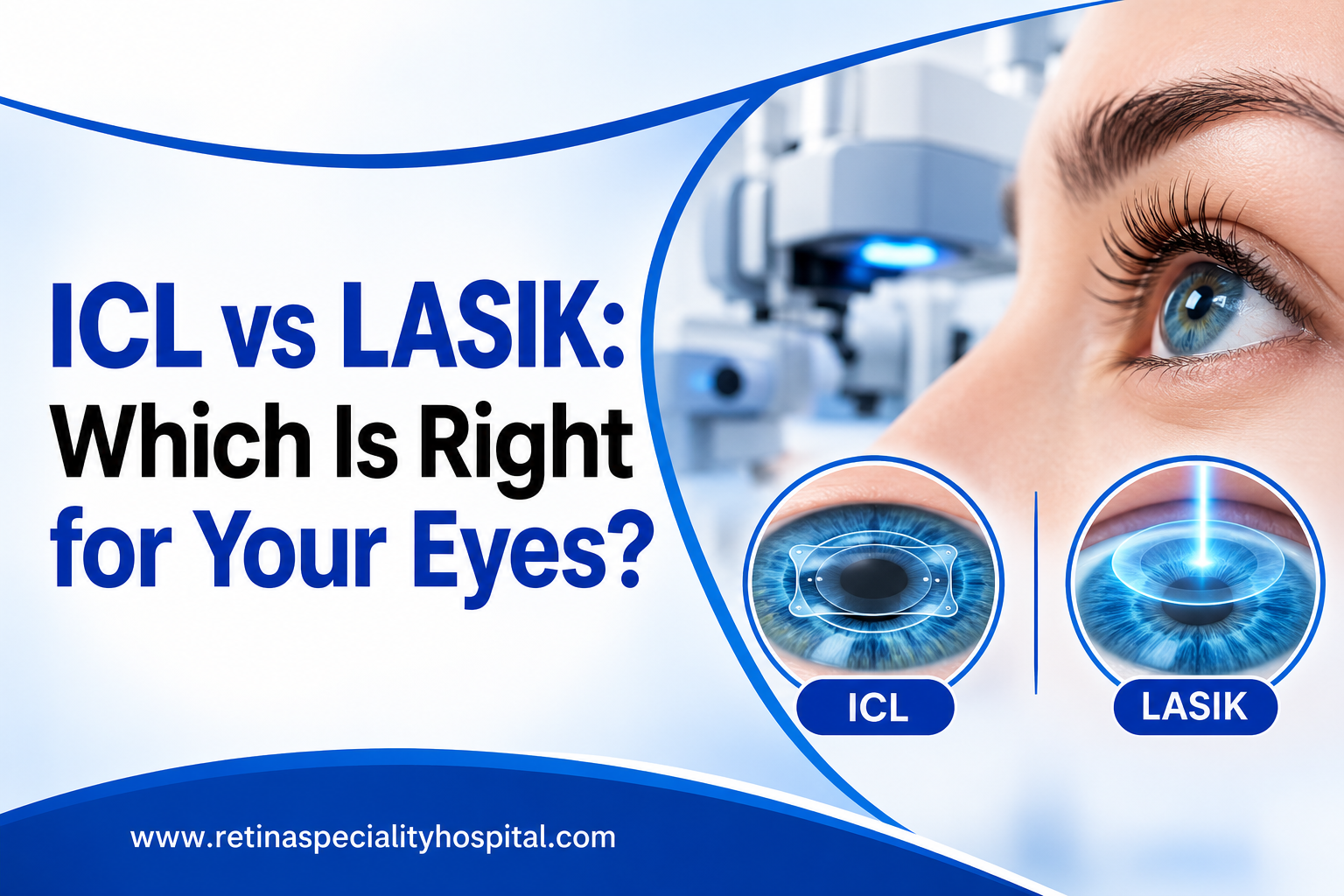
ICL (Implantable Collamer Lens) suits people with high eye power, thin corneas or dry eyes, while LASIK suits people with low-to-moderate power and a healthy, thick-enough cornea. ICL adds a lens inside the eye; LASIK reshapes the cornea with a laser. An eye exam decides which one fits.
Many people want to remove glasses (chashme ka number) but hear “LASIK is not possible for you.” A thin cornea or very high power is the usual reason. ICL is often the next option to consider. Below, the team at Retina Speciality Hospital, Indore explains how the two procedures differ and who qualifies for each.
What is ICL (Implantable Collamer Lens)?
ICL is a thin, flexible lens made of collamer, a biocompatible material, placed inside the eye between the iris and the natural lens. The ICL works like a permanent contact lens inside the eye and corrects nearsightedness, farsightedness and astigmatism without removing corneal tissue.
ICL is a type of phakic intraocular lens, meaning the natural lens stays in place. The surgeon inserts the ICL through a very small incision, usually with numbing drops.
How does LASIK work?
LASIK (laser-assisted in situ keratomileusis) reshapes the cornea with an excimer laser to correct eye power. The surgeon first creates a thin corneal flap, lifts it, removes a precise amount of tissue underneath, and replaces the flap. The reshaped cornea focuses light correctly.
Because LASIK removes corneal tissue, the cornea must be thick enough to stay strong afterward. Corneal thickness, shape and eye power decide eligibility.
ICL vs LASIK: how do they compare on power, cornea and dry eye?
ICL and LASIK differ mainly in where the correction happens: LASIK changes the cornea, while ICL adds a lens inside the eye. The table below shows how each procedure handles eye power, corneal thickness and dry eye, the three factors that most often decide the choice.
| Factor | ICL | LASIK |
| Where correction happens | Lens placed inside the eye | Cornea reshaped by laser |
| Eye power | Often chosen for high power | Best for low to moderate power |
| Corneal thickness | Thin cornea is usually not a barrier | Needs enough thickness after tissue removal |
| Dry eye | Usually less impact on tear surface | Can worsen dry eye, often temporarily |
| Tissue removed | None from the cornea | Corneal tissue permanently removed |
| Reversibility | Lens can be removed or replaced by a surgeon | Cornea change is permanent |
| Needs inside-eye space | Yes, depth and cell count are checked | No |
| Typical visual recovery | Usually within days | Usually within days |
Who is a good candidate for ICL?
A good ICL candidate has high eye power, a thin or irregular cornea, or dry eyes, along with a healthy eye interior. The eye needs enough space between the cornea and the natural lens, and a healthy inner corneal cell layer. A full eye exam confirms eligibility.
- High power: People whose power is too high for safe LASIK often qualify for ICL.
- Thin cornea: Because ICL leaves the cornea untouched, thin corneas are usually not the barrier they are for LASIK.
- Dry eye concerns: People with dry eyes may prefer ICL because the procedure does not reshape the corneal surface.
- Stable prescription and age: The prescription should be stable, typically for a year. Children and teenagers are not candidates; for them, the hospital offers child eye care in Indore.
Who is a good candidate for LASIK?
A good LASIK candidate has low-to-moderate eye power, a cornea thick enough after laser removal, a regular corneal shape and healthy tear production. LASIK works well when the numbers fit, and recovery is usually quick.
LASIK is generally not advised for people with a very thin cornea, irregular corneal shape (such as suspected keratoconus), very high power or significant dry eye. A corneal map (topography) checks these before any decision.
The 4-Gate Fit Check: how do you choose between ICL and LASIK?
The choice between ICL and LASIK comes down to four gates: power, cornea, dryness and inner-eye space. The 4-Gate Fit Check is a simple framework for discussing the decision with your surgeon. Passing all four gates for one procedure points to that option.
- Gate 1: Power. Is the eye power within the safe LASIK range? If power is high, ICL moves ahead.
- Gate 2: Cornea. Is the cornea thick enough and regularly shaped? If not, LASIK is usually out.
- Gate 3: Dryness. Do tear tests show dry eye? If yes, ICL deserves a serious look.
- Gate 4: Inner-eye space. Does the eye have enough depth and healthy corneal cells for an ICL? If not, ICL may be out.
Contrarian insight: A thin cornea does not make ICL automatic. In practice, patients turned away from LASIK sometimes assume ICL is guaranteed. ICL has its own anatomical gate (Gate 4), and some eyes fail it. The right question is which procedure fits your eye, not which is newer.
Why does a retina check matter before ICL or LASIK?
A retina check matters because high eye power (high myopia) is linked to a higher risk of retinal problems, such as retinal tears and detachment. Surgery on the front of the eye does not remove that risk. A dilated retina exam should come first. At Retina Speciality Hospital, Indore, patients with high power can have a retina check-up and refractive evaluation under one roof. A retina specialist in Indore can spot weak areas early and plan follow-up.
What are the risks of ICL and LASIK?
Both ICL and LASIK are safe procedures when patients are well selected, but each carries specific risks. ICL risks mostly involve the inside of the eye, while LASIK risks mostly involve the cornea and tear surface. Understanding them helps patients decide.
- ICL: cataract formation. The lens sits near the natural lens, so a cataract can develop in some patients over time.
- ICL: eye pressure changes and corneal cell loss. Regular follow-up checks pressure and the inner corneal cell layer.
- ICL: infection and lens positioning issues. These are uncommon but need prompt care.
- LASIK: dry eye. Dryness is the most common side effect and is often temporary.
- LASIK: flap problems, glare and halos. Night-time glare can occur, especially in the early weeks.
- LASIK: corneal weakening (ectasia). This rare problem is why corneal screening before surgery matters.
What is the step-by-step process for ICL or LASIK?
The process for both ICL and LASIK starts with detailed testing, followed by surgery and structured follow-up. Surgery itself is usually short and done with numbing drops. Careful testing beforehand matters more than the procedure time.
- Comprehensive eye exam. The surgeon checks power, tear film, eye pressure and general eye health.
- Corneal and inner-eye mapping. Corneal topography and thickness checks apply to LASIK. Inner-eye measurements apply to ICL.
- Dilated retina exam. The retina is checked, which is especially important with high power.
- Procedure choice. The surgeon explains which option fits using the 4-Gate Fit Check.
- Surgery day. The procedure is done with numbing drops, one eye after another.
- Early follow-up. Check-ups usually happen the next day and within the first week.
- Long-term monitoring. Regular reviews continue, especially after ICL.
Why choose Retina Speciality Hospital, Indore for vision correction?
Retina Speciality Hospital, Indore combines retina expertise with eye care, which matters for patients with high power. People searching for the best eye hospital in Indore or the best eye doctor in Indore should look for thorough pre-surgery testing, not just the procedure name.
- Retina-led safety check: Dr. Arun Bhargava, Senior Consultant and Vitreoretinal Surgeon, helps assess retinal health before vision correction.
- Cataract and lens expertise: Dr. Avani Ghodgaonkar, Senior Cataract Surgeon, brings lens-surgery experience relevant to inside-the-eye procedures like ICL.
What should you ask your surgeon? (Checklist)
Asking the right questions before surgery prevents surprises. Bring this checklist to your consultation and ask the surgeon to answer each point.
- Is my eye power in the safe LASIK range?
- How thick is my cornea, and is the shape regular?
- Do I have dry eye, and how does it affect my choice?
- Do my inner-eye measurements allow an ICL?
- Has my retina been checked with dilation?
- What are the specific risks for my eyes?
- What follow-up schedule do you recommend?
Key Takeaways
- Core difference: LASIK reshapes the cornea. ICL adds a lens inside the eye.
- ICL fits: High power, thin cornea or dry eye, if the inner eye is healthy.
- LASIK fits: Low-to-moderate power, adequate corneal thickness and a regular cornea.
- Retina first: High power raises retinal risk, so a dilated retina exam matters.
- Decision rule: Use the 4-Gate Fit Check, then confirm with your surgeon.
FAQs aBOUT ICL vs LASIK
Is ICL better than LASIK?
Neither is better for everyone. ICL often suits high power, thin corneas or dry eyes, while LASIK suits low-to-moderate power with a healthy cornea. The better option is the one that fits your eye measurements, confirmed by a full examination.
Can I get ICL if I have a thin cornea?
Often yes. ICL does not remove corneal tissue, so a thin cornea is usually not a barrier. However, ICL needs enough space inside the eye and healthy inner corneal cells, so your surgeon must check these first.
Is ICL permanent, or can it be removed?
ICL is designed to stay in the eye long term, but a surgeon can remove or replace the lens if needed. LASIK permanently changes the cornea. Reversibility is one reason some patients prefer ICL.
Does ICL cause dry eye?
ICL usually has less impact on the tear surface than LASIK because the cornea is not reshaped. Dryness can still occur, so patients with dry eye should have a tear assessment first. Your surgeon will advise on your case.
What age can you have ICL or LASIK?
Both procedures are for adults whose prescription has stayed stable, typically for about a year. Children and teenagers are not candidates. Your surgeon confirms eligibility after an exam.
Not sure whether ICL or LASIK fits your eyes? Book a vision correction and retina check-up at Retina Speciality Hospital, Indore. Our team will map your cornea, check your retina and explain your options clearly.
Medical disclaimer: This article is for general information and does not replace a personal eye examination. Always follow your surgeon’s advice.