






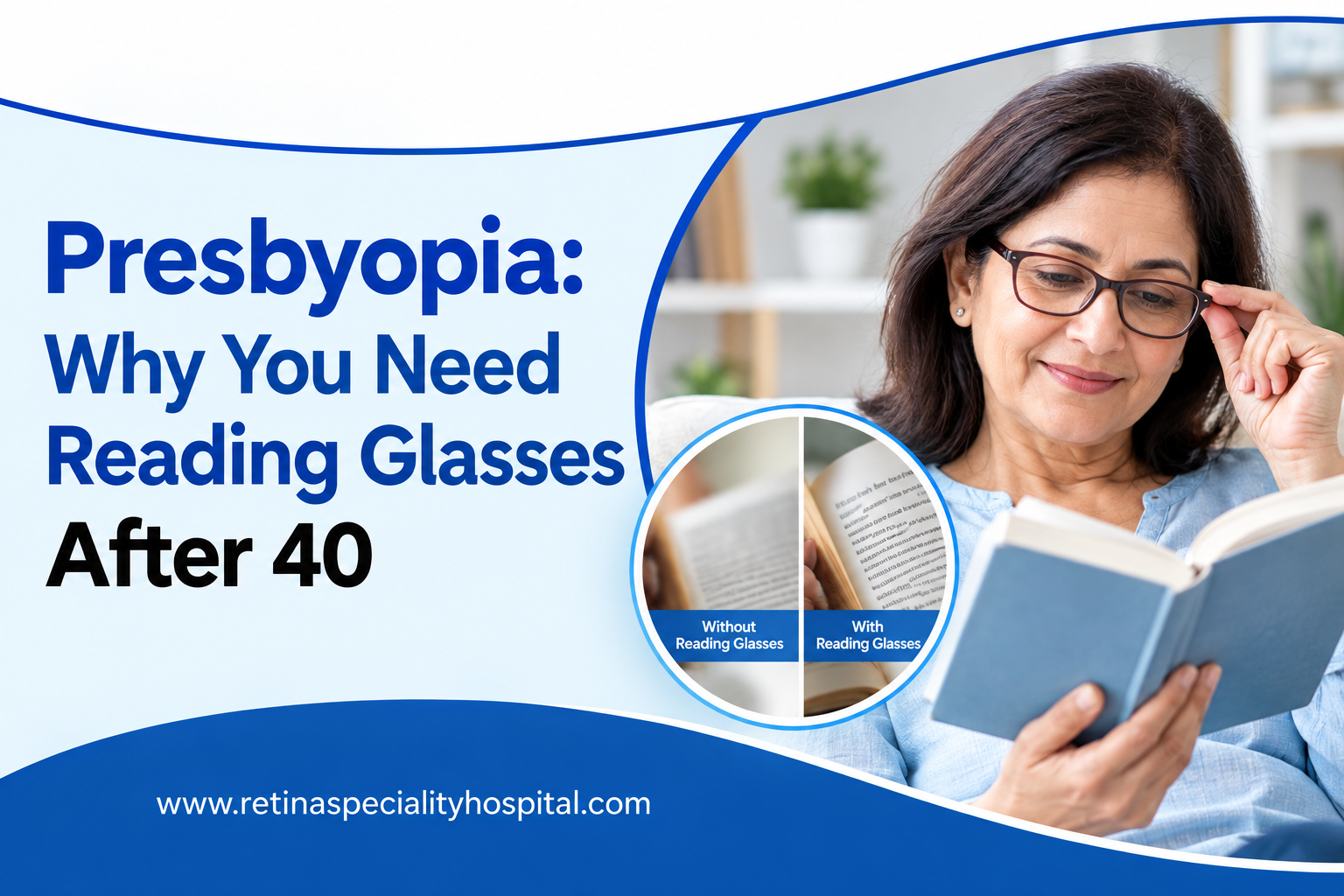
Presbyopia is a natural, age-related condition where the eye’s lens gradually loses flexibility, making it harder to focus on close-up objects such as text messages, menus, or books. It typically begins between the ages of 40 and 45 and affects nearly everyone eventually, regardless of whether you’ve needed glasses before.
If you’ve recently found yourself holding your phone farther away to read a message, you’re not alone. This guide from Retina Speciality Hospital, a trusted eye hospital in Indore, explains why presbyopia happens, its symptoms, and the treatment options available at the best eye hospital in Indore.
What Is Presbyopia?
Presbyopia literally means “aging eye.” It occurs because the natural lens inside your eye becomes less flexible over time, reducing its ability to change shape and focus on nearby objects. This process, called accommodation, works smoothly in younger eyes but slows down with age.
Unlike nearsightedness (myopia) or farsightedness (hyperopia), which are refractive errors present from a younger age, presbyopia is a normal, unavoidable part of aging that affects the lens itself. It cannot be prevented through lifestyle changes, diet, or eye exercises.
Why Does Presbyopia Happen?
To understand presbyopia, it helps to think of your eye like a camera lens. Your cornea bends incoming light, while a tiny circular muscle around the lens contracts or relaxes to change the lens’s shape, bringing objects at different distances into focus.
In your 20s and 30s, this lens is soft and flexible, so focusing on both near and far objects happens almost instantly. After age 40, the lens becomes stiffer and less elastic, making it progressively harder to focus on close-up tasks like reading, sewing, or using a smartphone.
Common Symptoms of Presbyopia
Presbyopia symptoms usually develop gradually and become more noticeable as you move through your 40s and 50s:
- Difficulty reading small print, especially in dim lighting
- Needing to hold books, menus, or phones farther away to see clearly
- Eye strain or fatigue after reading or close-up work
- Headaches after prolonged near tasks
- Blurred vision when switching focus between near and far objects
- Needing brighter light to read comfortably
If you already wear glasses or contact lenses for distance vision, you may notice these symptoms even while wearing your existing prescription, since presbyopia affects near focus regardless of any other vision correction you use.
Presbyopia vs Other Refractive Errors
| Feature | Presbyopia | Myopia (Nearsightedness) | Hyperopia (Farsightedness) |
| Cause | Age-related lens stiffening | Eye too long, or cornea too curved | Eye too short, or cornea too flat |
| Onset | Typically after age 40 | Often in childhood or teens | Can be present from birth |
| Affects | Near vision only | Distance vision | Both near and distance in some cases |
| Progression | Worsens gradually until mid-60s, then stabilizes | Can stabilize in adulthood | Varies |
| Preventable | No, it’s a normal aging process | Partially, with lifestyle factors | No |
It’s also worth noting that presbyopia can occur alongside myopia or hyperopia. If you’re nearsighted and over 40, you may still need a separate near-vision correction added to your existing prescription.
How Common Is Presbyopia?
Presbyopia is extremely common and, in practical terms, will eventually affect nearly every adult. Most people begin noticing symptoms in their early to mid-40s, and near vision continues to decline gradually until it levels off around the mid-60s. This makes it one of the most frequent reasons adults visit an eye doctor for the first time in decades.
How Is Presbyopia Diagnosed?
A comprehensive eye exam is the first step to confirming presbyopia and ruling out other conditions with overlapping symptoms. At a well-equipped eye care centre Indore residents trust, this typically includes:
- A detailed vision and refraction test to measure your current near and distance prescription
- A general eye health check to rule out cataract, dry eye, or other causes of blurred vision
- A discussion of your daily visual needs, such as reading, computer work, or driving, to guide the best correction option
Treatment Options for Presbyopia
While presbyopia cannot be reversed, it can be corrected very effectively. Options range from simple glasses to permanent surgical solutions:
Non-surgical options:
- Reading glasses – the simplest and most immediate solution
- Bifocal lenses – combine distance and near correction in one lens, separated by a visible line
- Progressive lenses – offer a smooth transition between distance, intermediate, and near vision without a visible line
- Multifocal contact lenses – provide near and distance correction without glasses
Surgical options (usually considered after age 45 to 50, once prescription stabilizes):
- LASIK monovision – one eye is corrected for distance and the other for near vision
- Refractive lens exchange (RLE) – replaces the natural lens with an artificial multifocal lens
- PresbyLASIK – a laser procedure creating multifocal focus zones on the cornea
- Corneal inlays – a small implant placed in one eye to improve near focus
The right option depends on your lifestyle, existing prescription, and how much you’d like to reduce your dependence on glasses. A consultation with a retina specialist in Indore or comprehensive ophthalmologist can help you choose confidently.
When Should You See an Eye Doctor?
While presbyopia itself isn’t a disease, some of its symptoms overlap with more serious eye conditions. You should schedule an eye exam if you experience:
- Sudden or significant blurring of vision, not just gradual near-vision difficulty
- Eye pain along with blurred vision
- Flashes of light, floaters, or a curtain-like shadow in your vision
- Any vision change that seems unusual for typical age-related presbyopia
A thorough checkup, including a retina check up Indore patients can rely on, ensures that what looks like simple presbyopia isn’t masking another underlying issue.
Key Takeaways
- Presbyopia is a normal, age-related loss of near-focusing ability that begins around age 40
- It cannot be prevented, but it can be corrected with glasses, contact lenses, or surgery
- Common symptoms include blurred close-up vision, needing more light to read, and eye strain
- Presbyopia can occur alongside myopia or hyperopia and needs separate correction
- Regular eye exams help distinguish normal presbyopia from other, more serious causes of blurred vision
FAQs About Presbyopia
1. At what age does presbyopia usually start?
Most people begin noticing presbyopia symptoms between ages 40 and 45. It progresses gradually and typically stabilizes by the mid-60s.
2. Can presbyopia be prevented with eye exercises or diet?
No. Presbyopia is caused by natural, age-related stiffening of the eye’s lens and cannot be prevented or reversed through eye exercises, diet, or lifestyle changes.
3. Do I still need reading glasses if I’ve had LASIK before?
Yes, in most cases. Standard LASIK corrects distance vision but doesn’t prevent presbyopia, since it affects the natural lens rather than the cornea. Many patients who’ve had LASIK still eventually need reading glasses or a specific presbyopia-correcting procedure.
4. Is presbyopia the same as farsightedness?
No, although the two are often confused. Farsightedness (hyperopia) is a refractive error that can occur at any age due to eye shape, while presbyopia is specifically caused by age-related lens stiffening and typically starts after 40.
5. What is the fastest way to correct presbyopia?
Reading glasses provide the fastest and simplest correction and work well for the vast majority of people with presbyopia. For those wanting to reduce dependence on glasses, options like progressive lenses, multifocal contacts, or surgical procedures can be discussed with an eye specialist.
Struggling to read fine print or feeling constant eye strain after 40? Visit Retina Speciality Hospital, recognized among the best eye hospitals in Indore, for a comprehensive eye exam. Our specialists will confirm whether it’s presbyopia and guide you to the correction option, whether glasses, contact lenses, or surgery, that fits your lifestyle best.