








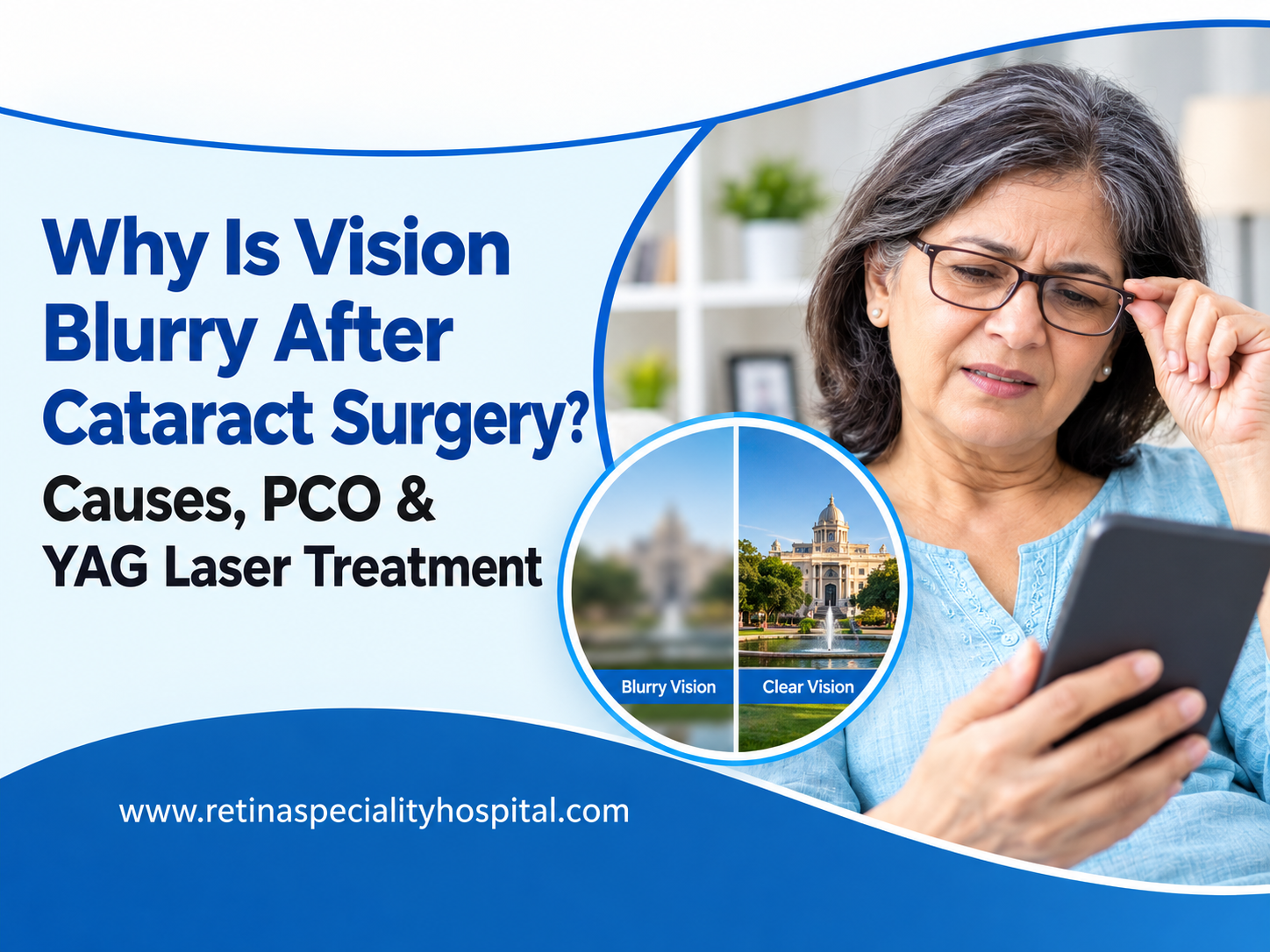
Blurry vision after cataract surgeryin indore is common in the first few days or weeks and is usually part of normal healing. If it appears months or years later, the most common cause is Posterior Capsule Opacification (PCO), also called a “secondary cataract”. PCO is not a new cataract. It is a clouding of the thin membrane that holds your lens implant. It is treated in minutes with a painless YAG laser capsulotomy.
Other causes include dry eye, a change in glasses power, swelling in the retina, or other eye conditions. Sudden vision loss, pain, or redness needs urgent care.
Is It Normal to Have Blurry Vision After Cataract Surgery?
Yes, for a short time. After cataract surgery, the eye needs time to heal and adjust to the new artificial lens (IOL).
Most people notice:
• Mild blur or haze in the first 24 to 72 hours
• Light sensitivity and watering
• Gradual improvement over the next few days to weeks
Full stability of vision can take a few weeks. Your surgeon will confirm this at your follow-up visits.
When it is not normal: blur that gets worse, or sudden vision drop, pain, or redness after the first few days.
What Are the Causes of Blurry Vision After Cataract Surgery?
The table below summarizes the common causes and when each usually appears.
| Cause | When it appears | Is it serious? | Typical treatment |
| Normal healing and corneal swelling | First days to weeks | No | Prescribed eye drops, time |
| Dry eye | Weeks to months | Usually mild | Lubricating drops, dry eye care |
| Residual refractive error (glasses power) | After healing | No | Glasses, or in some cases laser vision correction |
| PCO (secondary cataract) | Months to years | Mild, easily treatable | YAG laser |
| Cystoid macular edema (CME) | Weeks after surgery | Needs treatment | Anti-inflammatory drops, retina care |
| Retinal problems (diabetic retinopathy, macular degeneration, retinal detachment) | Anytime | Can be serious | Retina specialist evaluation |
| Infection or high eye pressure | Early, usually days | Emergency | Immediate medical attention |
Let us look at the most important ones.
1. Normal Healing
The eye is recovering from a small incision. Corneal swelling and inflammation can cause temporary blur. Using your prescribed drops on time is important at this stage.
2. Dry Eye
Surgery can temporarily affect the tear film. This may cause a fluctuating, gritty, or blurry feeling, especially while reading or using screens.
3. Need for Glasses
Even with a successful surgery, some people need glasses for reading or fine distance correction. This is a power issue, not a complication.
4. Posterior Capsule Opacification (PCO)
This is the leading cause of blurry vision that returns after a good initial recovery. We explain it in detail below.
5. Retinal Causes
If the back of the eye (retina) has a problem, vision may stay blurry even after a perfect surgery. Conditions like diabetic retinopathy, macular swelling, or macular degeneration need a retina specialist in Indore for proper diagnosis.
What Is PCO (Posterior Capsule Opacification)?
PCO is a clouding of the capsule, a thin transparent membrane that stays behind in your eye to support the artificial lens after cataract surgery. Over time, cells can grow on this membrane and make it hazy. Light then cannot pass clearly, and vision becomes blurry again.
Key facts about PCO:
• It is not a return of the cataract. The natural lens was already removed.
• It can appear months or years after surgery.
• It is common. Studies report that a significant share of patients (often cited as up to around 20% within five years) develop it.
• It does not mean your surgery went wrong.
• It is easily treated and does not damage the eye.
Symptoms of PCO
• Gradual cloudy or hazy vision
• Glare and halos around lights, especially at night
• Difficulty reading or driving
• Faded colors
• Feeling that your old cataract symptoms are back
There is usually no pain or redness with PCO.
How Is PCO Treated? YAG Laser Capsulotomy
PCO is treated with a Nd:YAG laser capsulotomy. The doctor uses a focused laser to create a tiny opening in the cloudy capsule, so light can pass through again.
Step-by-Step: What Happens During YAG Laser Treatment
1. Eye examination: Your doctor confirms PCO and checks the rest of your eye health.
2. Dilating drops: Your pupil is widened.
3. Numbing drops: A drop is used for comfort. No injection is needed.
4. Laser application: You sit at the laser machine. The laser is applied for a few minutes.
5. Pressure check: Eye pressure may be checked after the procedure.
6. Go home: It is an OPD (day-care) procedure.
What to Expect
| Factor | Details |
| Duration | Usually about 5 to 10 minutes |
| Pain | Generally painless |
| Anesthesia | Numbing eye drops |
| Recovery | Vision often improves within hours to a couple of days |
| Hospital stay | Not required |
| Can PCO come back? | No, once the capsule is opened, PCO does not return |
Possible Risks (Rare)
• Temporary rise in eye pressure
• New floaters
• Retinal detachment (very rare)
• Macular swelling (rare)
Your surgeon will explain these based on your eye.
Does Laser Cataract Surgery Prevent PCO?
Not completely. Laser cataract surgery (femtosecond laser-assisted) is used to assist steps such as the incision and lens softening. It does not eliminate the chance of PCO later. Also, the YAG laser used for PCO is a different procedure from the laser used during surgery.
Choosing the right method depends on your eye, and your surgeon is the best person to guide you.
Can Corrective Laser Eye Surgery Help After Cataract Surgery?
If blur is due to leftover glasses power and not PCO or any disease, corrective laser eye surgery (such as LASIK or PRK) may be considered in selected patients to fine-tune vision. Not everyone is a candidate. A detailed eye evaluation is needed first.
When to See an Eye Doctor Immediately
Contact your eye hospital urgently if you notice:
• Sudden drop in vision
• Increasing eye pain
• Redness that is getting worse
• Flashes of light or a sudden shower of new floaters
• A dark curtain or shadow in your vision
• Swelling of the eyelid or discharge
These can be signs of infection, retinal problems, or raised pressure, and need immediate attention.
How to Reduce the Risk of Problems After Cataract Surgery
• Use all prescribed drops exactly as advised
• Avoid rubbing the eye
• Protect the eye from dust and water in the early days
• Do not skip follow-up visits
• Manage diabetes and blood pressure well
• Get regular eye check-ups, even if you see well
Cost: Motibindu Operation Cost and YAG Laser Cost in Indore
Many patients search for motibindu operation cost (cataract surgery cost) before deciding. The cost depends on:
• Type of surgery (standard phaco or laser-assisted)
• Type of intraocular lens (monofocal, multifocal, toric)
• Hospital facilities and surgeon experience
• Eye condition and any additional treatment
• Insurance or cashless coverage
YAG laser for PCO is generally a much smaller procedure than cataract surgery and costs less.
Who Are the Best Cataract Surgeons in Indore?
Cataract surgery at Retina Speciality Hospital is led by Dr. Ritu Verma and Dr. Rohit Khatri. Whether you need standard phacoemulsification, a premium multifocal lens, or complex cataract management, your surgeon will guide you after a detailed eye examination.
Dr. Ritu Verma
Senior Consultant, Cataract, Refractive & Cornea Surgeon
Qualifications: MBBS, DOMS (Ophthalmology)
Specialities:
• Cataract & IOL Surgery
• LASIK (Refractive Surgery)
• Cornea
• Conjunctivitis
Book Appointment with Dr. Ritu Verma
Dr. Rohit Khatri
Senior Consultant, Cataract, Refractive & Glaucoma
Qualifications: MBBS, MS, FNABEH, FICO
Experience: Ex-Consultant, Sankara Eye Centre, Indore; Ex-Consultant, Dr. Agarwal’s Eye Hospital, Indore
Specialities:
• Cataract Surgery
• Refractive Surgery
• Glaucoma Management
Book Appointment with Dr. Rohit Khatri
Choosing the Right Eye Hospital in Indore
When searching for the best eye hospital in Indore or cataract doctors near me, look for:
• Experienced cataract and retina specialists under one roof
• Modern diagnostic and laser technology
• Clear explanation of lens options and costs
• Proper follow-up care
• Transparent communication
At Retina Speciality Hospital, our eye care centre in Indore offers complete cataract evaluation, laser treatment, and retina care, so the cause of your blur is identified correctly.
FAQs About Vision Blurry After Cataract Surgery
1. Why is my vision blurry after cataract surgery?
It can be normal healing, dry eye, a change in glasses power, PCO, or a retinal issue. A check-up will identify the exact cause.
2. How long does blurry vision last after cataract surgery?
Healing blur usually improves within days to a few weeks. If it continues or gets worse, consult your doctor.
3. Can cataracts grow back after surgery?
No. The natural lens is removed. What can happen is PCO, which feels like a cataract coming back.
4. Is YAG laser treatment painful?
It is generally painless. Most people feel little or no discomfort.
5. How soon will I see clearly after YAG laser?
Many people notice improvement within a few hours to a couple of days.
6. Is PCO dangerous?
No, it is not harmful to the eye, but it can reduce vision until treated.
7. Can PCO happen after laser cataract surgery?
Yes. Laser cataract surgery does not fully prevent PCO.
8. Do I need a hospital stay for YAG laser?
No. It is a short OPD procedure.
9. What is the motibindu operation cost in Indore?
It depends on the surgery type, lens choice, and hospital. Visit us for a personalized estimate.
10. When should I worry about blurry vision after surgery?
Seek immediate care for sudden vision loss, pain, increasing redness, flashes, or a dark curtain.
11. Who are the cataract surgeons at Retina Speciality Hospital, Indore?
Cataract surgery is led by Dr. Ritu Verma, a Senior Consultant in Cataract, Refractive and Cornea Surgery, and Dr. Rohit Khatri, a Senior Consultant in Cataract, Refractive and Glaucoma care.
Conclusion
Blurry vision after cataract surgery is common and often temporary. If it appears weeks or years later, PCO is the most likely reason, and it can be treated quickly with a painless YAG laser. Do not ignore sudden or worsening symptoms. Early evaluation protects your vision.
Book Your Eye Check-Up Today
If you or a family member is facing blurry vision after cataract surgery, consult our cataract surgeons, Dr. Ritu Verma and Dr. Rohit Khatri, at Retina Speciality Hospital, Indore. Call
0731-2553377 or Book an Appointment now.